




From Sand Creek to Gaza City, the massacres don't stop
Sep 03, 2025
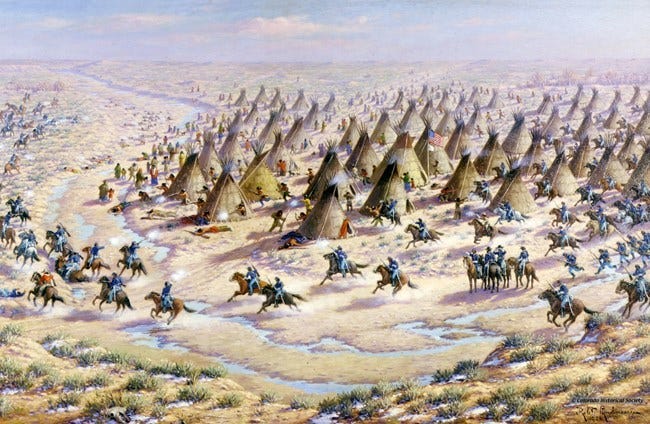
The cavalry against grandmothers at Sand Creek Image: National Park Service
Genocide: “The deliberate killing of a large number of people from a particular nation or ethnic group with the aim of destroying that nation or group.” The Oxford Dictionary
Author’s warning: A lot of anti-American facts coming, but I’m not saying the US is uniquely evil. It does horrible things, but other countries do, too. It became colonizer-in-chief largely by historical accident. The point is to understand how our history deforms our society, so we can survive and change it.
Thanks for reading Make Earth Sacred Again! Subscribe for free to receive new posts and support my work.
—
When I condemn their murderous assault on Gaza, Israel defenders often reply, ”Oh, yeah? How can you Yanks criticize us? We’re just doing what America does.”
It’s sometimes hard to dispute the Zionists’ argument, because it’s true. America has been committing genocide against indigenous people since before the USA existed. Millions have been killed; their lands taken. They were starved, shot, and exiled on long marches to distant reservations. That history really does resemble what’s happening in Palestine now.
According to the Houston Holocaust Museum, between 1492 and 1900, the Indigenous population of the Americas dropped by about 90%, from an estimated 60.5 million to just 6 million.
“Native Americans were subjected to many different forms of violence,” they write, “all with the intention of destroying the community. For example, European settlers in Maine were paid for each Penobscot person they killed.” There were frequent massacres like the one of Cheyenne and Arapaho people at Sand Creek in 1864, where the Army killed 230 innocents, mostly women and children.
Shortly after their arrival, European settlers started a second genocide; this one against African people kidnapped from their homeland and brought here as slaves. The Equal Justice Initiative reports, “The Transatlantic Slave Trade represents one of the most violent, traumatizing, and horrific eras in world history. Nearly two million people died during the barbaric Middle Passage across the ocean. The African continent was left destabilized and vulnerable to conquest and violence for centuries. The Americas became a place where race and color created a caste system defined by inequality and abuse.” [ See how history molds us without our knowing it?]
While slavery officially ended after the Civil War, the genocide continued with segregation, mass imprisonment, discrimination in employment and housing, and police murder of Black civilians. This is all basic history that everyone should know, although still often denied, and teaching of it discouraged or banned.
Genocidal assaults on indigenous people have not stopped or even slowed. Sometimes, as in Palestine, America just supplies the weapons and the political cover and lets Israel or others do the actual killing. When an oil company poisons a rainforest with their wells, or a mining company destroys a mountain with their chemicals, or a lumber company cuts down a forest, what happens to the people who live there and rely on the land? They leave or die.
Ecocide: destruction of the natural environment by deliberate or negligent human action.
As with the deforestation example, exterminating indigenous people usually involves killing their environment. Genocide heavily overlaps with ecocide. We can see this in the rubble of Gaza now, but eco/genocide is usually less spectacular. The mass spraying of herbicides like Agent Orange on the jungles of Viet Nam, intended to deny cover to the guerillas, was genocidal for the inhabitants. People, forests, and fish are still dying from the poisons today.
I’m going to go a step farther and allege that ecocide and genocide are the same process. There is a genocidal quality to the way we treat the Natural world, including the animals. While indigenous people and slaves are dehumanized, made into lesser beings who can be worked to death or slaughtered, non-humans are treated as lifeless objects. Corporations clear-cut a forest; we use the wood and don’t worry about the sacrificed trees or birds. Factory farms confine animals in tiny pens for their whole lives. Then we eat them and never consider their suffering or even bother to thank them.
That’s what living in a genocidal culture does to our hearts and souls. You can’t spend generations learning that some people are inferior and deserving of death, and expect that your view of the world will not be warped. In this light, it’s not hard to see where a Hitler or a Netanyahu come from.
In this article I want to examine how genocide permeates our language, our economy, and our entire culture. If we understand this, we might be able to move away from it.
Language of dehumanization
We do not speak of humans destined for genocide as people. Hamas members or Gazans are never people or fighters. They are always terrorists or Jihadists. African-Americans haven’t been people as often as they’ve been ‘coons,’ ‘niggers,’ ‘bucks’ ‘mammies,’ or some other epithet. Arabs in Iraq were called ‘sand niggers.’ Koreans and Vietnamese were ‘gooks.’ All these people were attacked with genocidal violence in US wars, and most of those insults are still used. Native Americans were always called ‘savages,’ and now are rarely mentioned as individuals at all.
Animals and plants are not just dehumanized; they are de-animated, not even alive. Have you noticed how only humans get to be living things in English? Humans are he or she; everybody else is an “it.” It’s a lot easier to abuse and kill a lifeless thing than to kill a person.
In Braiding Sweetgrass, Native American botanist Robin Wall Kimmerer explains how most of what English speakers call “things” are classed as “people” in her native language, Potawatomi. They use different verb and adjective forms for living things than for inanimate objects, which are usually man-made. Mountains, trees, squirrels, rocks, rivers, etc. use the living forms.
Think about how our sense of the world gets diminished and damaged by characterizing so many people as subhuman and so much of life as inanimate. We could be living in a much richer, more beautiful world if our language wasn’t always setting us up to kill it.
Mass culture
The culture of genocide in America dominates everything we read, view, and hear. In the 1950s and 60s, the dominant form of TV drama was the Western. On shows like Wagon Train, we watched and identified with the white settlers as they drove out the Indians. Movies of the time featured settler heroes like John Wayne outgunning enemy savages, whom audiences rarely got to meet. With toy guns, boys played ‘Cowboys and Indians’ for hours at a time, never thinking about that game’s terrifying origin. We literally grew up cheering for genocide.
Later, the nation’s attention turned to suppressing Black folks. Police shows became a huge genre. The reality show COPS, now in its 37th season, shows police hunting down mostly African-American bad guys. At the beginning of cinema, the movie Birth of a Nation famously celebrated the terrorist Ku Klux Klan.
Movies aren’t quite so bad now, but a huge number of American films glorify the military that fought genocidal wars in Korea, Vietnam and Iraq. Movies like Saving Private Ryan encourage youth to join the military. The Pentagon actually consults on most of these films.
Literature has also been imbued with genocide, consciously or not. Ray Bradbury’s great science-fiction novel The Martian Chronicles describes a space genocide: Americans coming to Mars, killing off the indigenous Martians and setting up a civilization that looked like America.
Economics of death
If genocide weren’t profitable, it wouldn’t happen. Capitalism will turn genocidal in a minute if it is not tightly controlled.
How? Capitalism converts everything into money. Nature becomes products; people become labor. Writer Adam Idek Hastie pointed out that “Under capitalism, a forest isn’t worth anything until it’s cut down.” Eric Williams, who led Trinidad and Tobago to independence, described in his book Capitalism and Slavery how the slave trade financed the industrial revolution and the vast expansion of often-genocidal colonialism.
Indigenous people may live in a rainforest, but if a corporation can make millions turning it into range land for beefburgers, the people will probably wind up dead or trying to survive in an urban slum. Palestinians have a rich culture they seek to defend, but Trump’s Bloodbath Riviera will make more money, so Gazans are being driven out. It may take years or generations, but genocide is the natural outcome of unrestrained capitalism. Everybody may not be killed, but the nation whose land capitalists want must be destroyed.
Where genocide has taken us
What does it do to people to live in a culture founded on genocide? We can see the results all around us: the cruelty of mass incarceration and homelessness, the endless wars, the pervasive mental illness, school shootings, and the wide-ranging racism against targeted groups.
Ecocide and genocide deform our lives and put the future at severe risk. Must we live in a world of inanimate things, unable to learn from or relate to nonhuman intelligences or to other humans of different races, cultures, or religions? That choice is making life much harder than it should be.
What we can do
In the year 2025, it seems clear that the US, the EU, Israel, and the white English-speaking world will maintain their genocidal ways. Against their people’s will, they are ramping up their murder to more insane levels. Left to their own devices, genocide and ecocide are what our leaders will do. It’s who they are; it’s where the money is, what the system is.
Can they be stopped? I’ve been reading people who have some ideas. We must unlearn our genocidal ways.
Given that genocide is driven by militarism, capitalism, and racism, all of which benefit powerful people, that goal might sound impossible. But then, no child is born genocidal. Kids love life and experience everything as alive and sentient. If we could stop teaching them genocide, the next generation would pull us in a better direction. We could start by teaching them Braiding Sweetgrass, or other indigenous wisdom books every couple of years.
Some other things we would need to do:
● Give land back to indigenous people. A little of this is already happening, like with the Yurok nation in northern California. They have gained ownership of land along rivers and are restoring them to health. We need to go beyond empty “land acknowledgements,” and restore land use decisions to indigenous representatives. They know best and are quite willing to teach.
● African-Americans must gain much more power over their communities. Outside corporations should be subject to local control over their operations. Community safety should be maintained by local organizations.
● Reparations. The federal government has given money to Japanese citizens for their ancestors’ internment in the 1940s, but not to Black people or Indians. Although state and local governments and some churches have apologized and paid money to African Americans and Indians for massacring them, the debts owed to indigenous Americans and to descendants of slaves are immense and have yet to be seriously addressed. These communities deserve money, but more than that they deserve power. The people made rich by the genocides should pay.
● American society must recognize its genocidal history. None of the reparations paid or apologies made so far have changed the culture’s attitude toward genocide or the attendant ecocide. That kind of reparation would have to go much deeper.
People of European ancestry would have to really learn and feel the violence of American culture. We should be teaching that history to kids of all ages every day. The idea is not to feel guilty, but to understand and do our best to make things right. At this point, though, our rulers seem intent on going the other way, banning what little education there is on racism and imperial history.
● Start to build a culture of caring, not of domination. Health care and housing for all would go a long way to creating a less violent, more rewarding society.
● Organize! Most people have no idea what’s going on. Reach out to coworkers and neighbors and share what you know. Join unions or activist organizations or create your own.
● If you are able, arm yourself and learn to shoot. Learn gun safety and skills. Nonviolence would be better, but we’re up against the people killing Gaza, the people who nuked Nagasaki, who sold their own out-of-marriage children into slavery. They don’t play.
As I wrote above, our current language, culture, and economic system all support genocide. We would have to change them. We could adopt a system like Chinese Socialism, in which people can profit and markets flourish, but only under the tight control of a national party that serves human and non-human people.
Stop referring to living things as “it.” We could add a pronoun like the French ‘on,’ a non-gendered way of referring to a third person. Most African, Asian, and indigenous languages have such a pronoun. I think referring to a rabbit, a tree, or a lake by the same pronoun as a person would change some attitudes toward Nature.
Finally, stop thinking one’s group, whatever it is, are superior to others and remember that everyone deserves life, liberty, and respect. Of course, it’s healthy to feel good about one’s group’s accomplishments or qualities, but it’s not OK to feel others are inferior or subhuman. We could make the idea of genocide unthinkable, as it already is for good people.
— -
Thanks for reading! Please comment, share, or repost, with or without attribution. Join my Substack community Make Earth Sacred Again. To hire me for freelancing, editing, or tutoring, e-mail me here.
#The_UN_Goals #humanrights #together #nvaction


