




We live in a graveyard and refuse to acknowledge the ghosts.
David Spero RN Oct 06, 2025
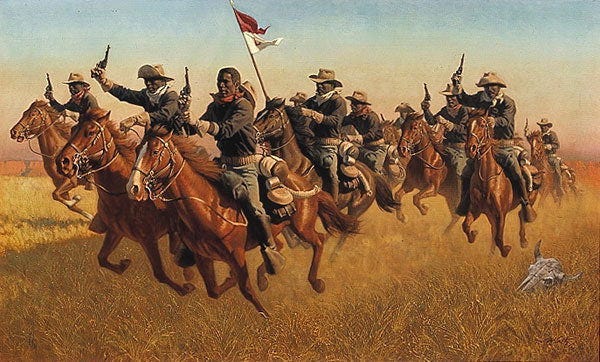
Death to the Natives! Image courtesy Vladimir Arts
The weekend of Sept 27–28 2025 saw no fewer than six mass shootings in the United States, bringing the 2025 total to 324, according to the Guardian. The web site Gun Violence Archive lists dozens of mass shootings each month. No other country not in a war zone has so many killings, and this number does not include single shootings, assassinations, drunk driving deaths, murders by other weapons, children beaten to death by abusers, or other socially caused mortality.
This is not a normal country. What makes us this way?
Our dysfunction originates in a society founded on genocide. Not one genocide, actually, but two: the near-extermination of the Indians, and the enslavement and mass murder of Africans. America has also participated in and sponsored genocides against indigenous people throughout the Americas, the Pacific, and the Middle East.
The violence against those groups and their dehumanization have continued through Jim Crow racism, mass incarceration, crippling poverty on reservations and ghettos, exclusion from forms of progress such as housing and education, and the Trump administration’s current war on immigrants.
What does it do to people to live in a world made and shaped by mass murder? We normally cope by ignoring this history or denying it. People who insist on bringing up the past are derided as “woke” and their words suppressed. We don’t teach it to children in schools. But the history doesn’t go away. It lives on in our bodies and in how we view the world.
We are all traumatized by our nation’s murderous history and racist present. What mental battles must we wage to feel OK about our country? About ourselves? How do those mental challenges affect the way we treat each other, and the kind of society we create?
It’s not hard to investigate the answers. Trauma is an experience so distressing that it changes the way one’s nervous system and brain function (called PTSD.) It makes us hypervigilant and stressed. Traumatized people lose compassion or the ability to see others as equal human beings. They’re too focused on surviving the threats they perceive all around.
Just as Israel is full of people comfortable with demanding ‘Kill all the children in Gaza,’ millions of Americans [though not a majority] support kidnapping immigrants and dropping bombs on people they don’t know. They can step around homeless people on the street and condemn those who give the homeless a handout. They’re wounded.
Genocide is traumatic for all concerned
The trauma undergone by a slave is different from the experience of the slave owner. Yet, both deform a person’s personality and view of the world. As psychologist Resmaa Manakem writes in My Grandmother’s Hands: Racialized Trauma and the Paths to Mending, those who witness trauma are traumatized, too. This is called vicarious trauma, like that experienced by many who witnessed the George Floyd murder video or have been watching news from Gaza for two years. According to Menakem, vicarious trauma also afflicts those who inflict trauma. Cops, for example, have two to four times the normal rates of PTSD.
One doesn’t have to experience traumatic events oneself to suffer from past traumas .We can get it from our parents, whose fear teaches us before we understand the words. This is called inherited, historical, or inter-generational trauma and affects almost everyone in the US today. Menakem cites the traumatic histories of most of the Europeans who came here, because Europe was a traumatic place to live. People could die in the streets of hunger and could be executed for stealing a loaf of bread.
Europe then offloaded most of that pain onto people of color through colonization and slavery. Descendants of slaves or indigenous victims of genocide often have more trauma than white people, but we all suffer.
I’m not saying Euro-Americans’ history of trauma excuses the trauma inflicted on others. Similarly, I don’t believe what was done to the Jews in Europe excuses what they do to Palestine, but it does go some way to explaining it. We don’t want to shame people about their ancestors’ behavior, but we must acknowledge it, because we need everyone to heal.
How our history of genocide affects us now
Committing multiple genocides distorts a society in obvious ways. For one, to do a genocide, you have to think of yourself as superior. You have to have a reason for the power of life and death you hold over others. You have to construct a narrative in which you are not a monster. Reading any of thousands of documents European settlers wrote about the native Americans or about their slaves will confirm that this process has been going on for hundreds of years.
Thinking of oneself as superior affects how one treats people. All homeless people can be disparaged. Police can abuse civilians. The deaths of thousands of Arabs or Africans barely make the news, while the deaths of a few white people get wall to wall coverage. Superiority becomes a habit; dehumanizing others becomes standard operating procedure.
The superiority and inferiority complexes created through traumatic violence make people easy to control. President Lyndon Baines Johnson (LBJ) said, “If you can convince the lowest white man he’s better than the best colored man, he won’t notice you’re picking his pocket. Hell, give him somebody to look down on, and he’ll empty his pockets for you.”
If that’s true, and LBJ should know, how important is his sense of superiority to that ‘lowest white man?’ How angry would he tend to become if someone took it away? Does this explain some of MAGA’s popularity? As systems researcher Elizabeth Halligan frames the issue, “White supremacy is a survival mechanism, a protective adaptation, rooted in inter-generational violence, a cultural amnesia, and a system that punishes vulnerability.”
Fascism and racism are genocide’s legacy.
After our two founding genocides, authoritarian rule never went away for the survivors. They periodically assert themselves and need to be suppressed, which accounts for militarized police and the gigantic prison industry. These repressive structures can be turned against all people if they start to rebel or become desperate, as was done by 20th century corporations against the labor movement and to immigrants now under Trump.
The ongoing racial divides in this country are also legacies of genocide. After a story of police brutality breaks, how many white people comment on social media, ’He must have done something to deserve that?’ How many Black people can look at a white coworker and think, ‘I can trust that person?’ Not many.
Genocide becomes a habit
America’s genocide never stopped. When all the Native Americans were dead or imprisoned on reservations, the military started conquering Latin America and the Caribbean. Then they moved into the Pacific, to Hawaii and the Philippines. All those conquests could be classed as genocidal under the UN’s Genocide Convention. Our rulers want the whole world; they think they need it for their own safety, and they can’t think outside their genocidal box.
Palestine is the most devastating genocide yet, because we can see it unfolding in real time but can’t seem to stop it. I think our rulers see genocide as normal, an unfortunate but necessary part of life.
The first genocide
I will take this one step deeper. I think the genocide habit started in capitalism’s treatment of animals and Nature. When Europeans arrived here, massive herds of buffalo covered the plains. Now they are dead, the few survivors raised for meat on privately owned reservations. Before colonization, enormous flocks of passenger pigeons could darken American skies for days. We hunted and deforested them to extinction, the last one dying in 1914.
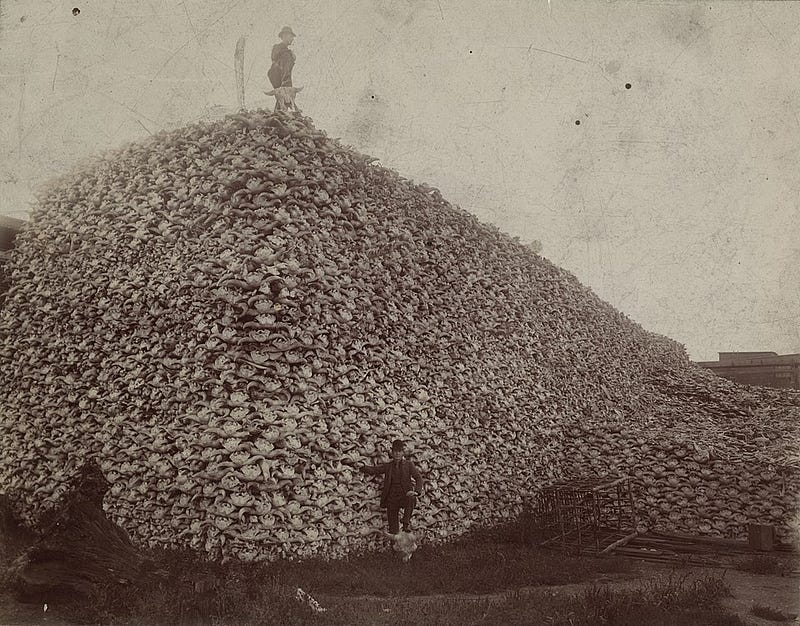
Mountain of bison skulls, each one a sentient being killed to deprive Natives of food. Image: wikimedia commons
Corporations couldn’t operate factory farms if they saw animals as beings worthy of compassion. We couldn’t clear cut forests if we respected all the living creatures there. People who torture and genocide animals have to think of those they kill as inferior beings not worthy of life. That attitude can easily be transferred on to humans. In fact, genocidal killers like Hitler and Netanyahu often speak of their victims as animals.
Can we heal?
Having embraced a genocidal worldview, can people unlearn it? Experts like Menakem and Halligan think we could heal intergenerational trauma, given a strong enough social commitment to change. But we would have to face our trauma honestly, and this is a very scary and painful prospect. It’s easier to deny it. A population ignoring the ghosts and acting out inherited traumas keep the system going and enrich the billionaire class, so those who profit will resist change.
Right now, leaders like Trump, Pete Hegseth, and Elon Musk do all they can to suppress knowledge of our traumatic history, because they are traumatized too. President Trump is a pedophilic bully who seems to care only about his self-image. Secretary of War Hegseth is an alcoholic conformity freak who prioritizes ‘lethality’, not effectiveness, as his military’s goal. Musk seems obsessed with populating the planet, and perhaps Mars, with his own progeny. These are wounded people, haunted by the ghosts of genocides past and present, inflicting their wounds on the world. But they didn’t start the fire; they’re just the latest operators of a centuries-old murder machine
Though I don’t know where we’d get the motivation to do it, we could in theory get out of this doom loop. We would need honesty, courage, and compassion, and it would take years of emotional and spiritual effort, but we could try.
— -
Thanks for reading! Please comment, share, or repost, with or without attribution. Join my Substack community Make Earth Sacred Again. To hire me for freelancing, editing, or tutoring, e-mail me here.
Thanks for reading Make Earth Sacred Again! Subscribe for free to receive new posts and support my work.
#The_UN_Goals #safeforall #together #nvaction


